Around San José this happens most in the first strong storms of the wet season, when wind arrives before the trees have shed their weak wood, and in neighborhoods with big mature canopy such as Willow Glen, the Rose Garden, Almaden Valley and the hills toward Saratoga and Los Gatos. This guide walks through the order things should happen in, because doing them out of order is what turns a bad night into an expensive month.
Safety Before Anything Else
Before anyone thinks about the roof, look at three things.
Power lines. Trees bring wires down with them. PG&E's guidance is to treat every downed line as live, keep well away from it and anything it touches (including a fence, a gutter or the tree itself), call 9-1-1, and then report it to PG&E at 1-800-743-5000. A branch lying across the service drop to your house counts. Nobody, including a tree crew or a roofer, should touch that tree until the utility has dealt with the line.
Gas. If you smell gas, leave the house first and call from outside.
The structure. If a ceiling is sagging, bulging with water or cracking, or you can see a branch through the drywall, keep everyone out of that room. A tree's weight is often still resting on the framing, and it can shift as wind moves the crown or as people start cutting.
And one rule that covers the rest of this article: do not go up on the roof. A roof with a tree on it is unstable in ways you can't judge from a ladder, and it is usually wet.
Inside the House: The First Hour
Once everyone is safe, the job is to limit what the water can reach. Move furniture, electronics and rugs out of the way, put buckets and towels under drips, and turn off the breaker for any light fixture or outlet that water is running near. Our guide on what to do when your roof is leaking covers the containment steps in more detail, including how to deal with a ceiling that is holding water.
Then take photographs and video before anything gets moved: the tree on the roof from several angles, the hole from inside, the attic if you can see into it safely, wet ceilings, and damaged belongings. Note the date and time. Those pictures matter more to an insurance claim than anything you write later, and once the tree is lifted off, the scene that explains the damage is gone.
Tree Crew First, Roofer Second
Homeowners often call a roofer first, which is understandable, but the order on site is almost always the same: the tree comes off, then the roof gets covered, then the damage gets assessed and repaired.
Removing a tree from a roof is tree work, not roof work. A large limb may need to be cut in pieces from the top down, or lifted off with a crane so its weight doesn't roll across the rest of the roof. Done carelessly, removal causes more damage than the fall did: a trunk dragged down a tile slope can break dozens of tiles that the original impact never touched. Hire a tree service that carries its own insurance and workers' compensation, and ask how they plan to take the weight off the house.
A roofer is useful at this stage even before work starts. We can tell the tree crew which parts of the roof can take a load and which can't, and be ready to cover the opening as soon as the tree is clear, so the house isn't left open to the next rain.
San José's Tree Rules Still Apply After a Storm
A tree that has partly failed often has to come down entirely, and in San José that can require a permit, even in an emergency. The City's tree removal rules turn on "ordinance-size" trees: those measuring 38 inches or more in circumference at 4½ feet above the ground (multi-trunk trees are measured by adding the trunks together). On a single-family or duplex lot, removing an ordinance-size tree requires a permit even if the tree is dead or unhealthy.
For a tree that really is about to fall, the City describes a faster path: an ordinance-size tree on private property that is an imminent hazard, supported by a signed report from a certified arborist, may qualify for a same-day, over-the-counter removal permit. Street trees, heritage trees and trees on public property are handled separately through the City Arborist, so if the tree that hit your house stands in the park strip by the curb, contact the City before anyone cuts it down.
Cutting branches off your roof to make the house safe is a different thing from removing the tree. But before the trunk comes down, confirm the permit question with the City's Planning Division or your arborist. Campbell, Saratoga, Los Gatos and other nearby cities have their own tree ordinances, and homes in unincorporated pockets fall under the County of Santa Clara, so the answer depends on which jurisdiction your house is in.
A Tarp That Survives the Next Storm
Once the tree is off, the opening needs to be closed the same day if rain is in the forecast. A good emergency tarp is more than plastic weighed down with bricks:
- It runs over the ridge where possible, so water can't get under the top edge.
- It is held with wood battens fastened through the tarp, not loose weights that blow off in the first gust.
- It extends well past the hole, because the damage nearly always spreads past what you can see.
- On a tile roof, it is laid so it doesn't break more tile. Concrete and clay tile crack under the wrong footstep, so the crew needs to know where to walk.
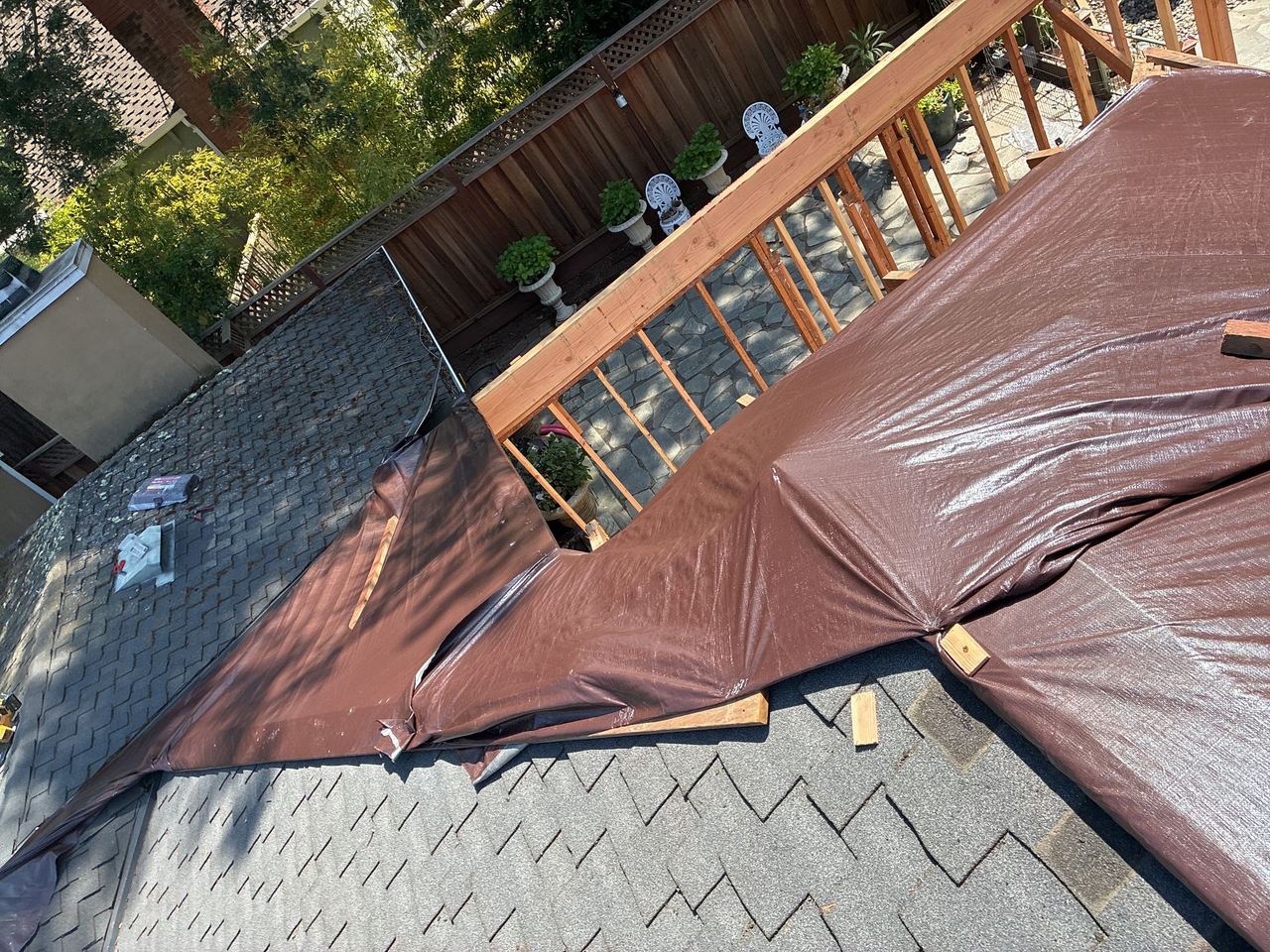
Keep the invoice for the tarp and any emergency work. Homeowners policies generally expect you to take reasonable steps to protect the house from further damage, and the cost of doing so is commonly treated as part of the claim. Check your own policy for the details.
The Insurance Side
A tree coming down in a storm is the kind of sudden, accidental event homeowners policies are written to cover, unlike wear and tear, which they generally exclude. A few points cause the most confusion.
It was the neighbor's tree. Generally, damage to your house is claimed on your own homeowners policy, whoever owned the tree. Your insurer may then try to recover what it paid from the neighbor or their insurer, particularly if the tree was visibly dead or diseased and they had been told about it. That is between the insurers, and it usually doesn't change how your repair gets done.
Removing the tree. Many policies cover removing a fallen tree when it has damaged a covered structure such as the house, often with a separate limit that is lower than people expect. A tree that falls across the yard without hitting anything may not be covered at all. Your policy's declarations page and the debris-removal section give the specifics.
Matching. This is where roofs get complicated. A repair with new shingles or tile next to twenty-year-old roofing rarely matches exactly, and some products are no longer made. California's claims regulations address this directly: when replaced items don't match in quality, color or size, the insurer is to replace all items in the damaged area so the result has a reasonably uniform appearance (California Code of Regulations, title 10, section 2695.9). What counts as the "damaged area" on a particular roof is often what the discussion with the adjuster turns on, so it helps to have a roofer document whether matching material is available and how far the repair has to run.
Documentation. Insurers move faster on a clear file: your photos from the night it happened, the tree service and tarp invoices, and a written roofing estimate with photographs that separates storm damage from any pre-existing wear. Our guide to roof age and home insurance in San Jose covers how carriers look at older roofs and the deadlines California sets for handling a claim.
If you live in a townhome or condo, tell your HOA right away. Depending on your CC&Rs, the association may be responsible for the roof and carry the policy that responds; our article on condo and townhome roof leaks in San Jose explains how that usually splits.
This is general information, not legal or insurance advice. Your own policy wording and your insurer or agent have the final word on coverage.
The Trees Still Over Your Roof
When one limb fails, look at the rest of the tree, and at its neighbors. A certified arborist can tell you whether a tree over the house has dead wood, weak branch unions or root problems, and what pruning would make it safer. Have it done before the storms, not after; our guide to getting a San Jose roof ready for the rainy season explains why the first big wind of the year is the one that brings limbs down.
Keep branches off the roof surface and out of the gutters, and remember that a street tree in front of the house falls under the City Arborist's rules, not just yours. If a storm has already done its damage, contact us or call (408) 295-8616, and we'll inspect the roof and attic, tarp what needs it, and give you a written scope you can share with your adjuster. You can also see how we handled an insurance-related repair with a matched shingle tie-in on our Saratoga roof repair project.
Frequently Asked Questions
Need professional help with your roof? Keith Roofing Company has been serving San Jose and the South Bay since 1952. We offer free estimates, honest recommendations, and work that's backed by BBB A+ Accreditation and CSLB License #1118418. Schedule a free estimate or call (408) 295-8616.